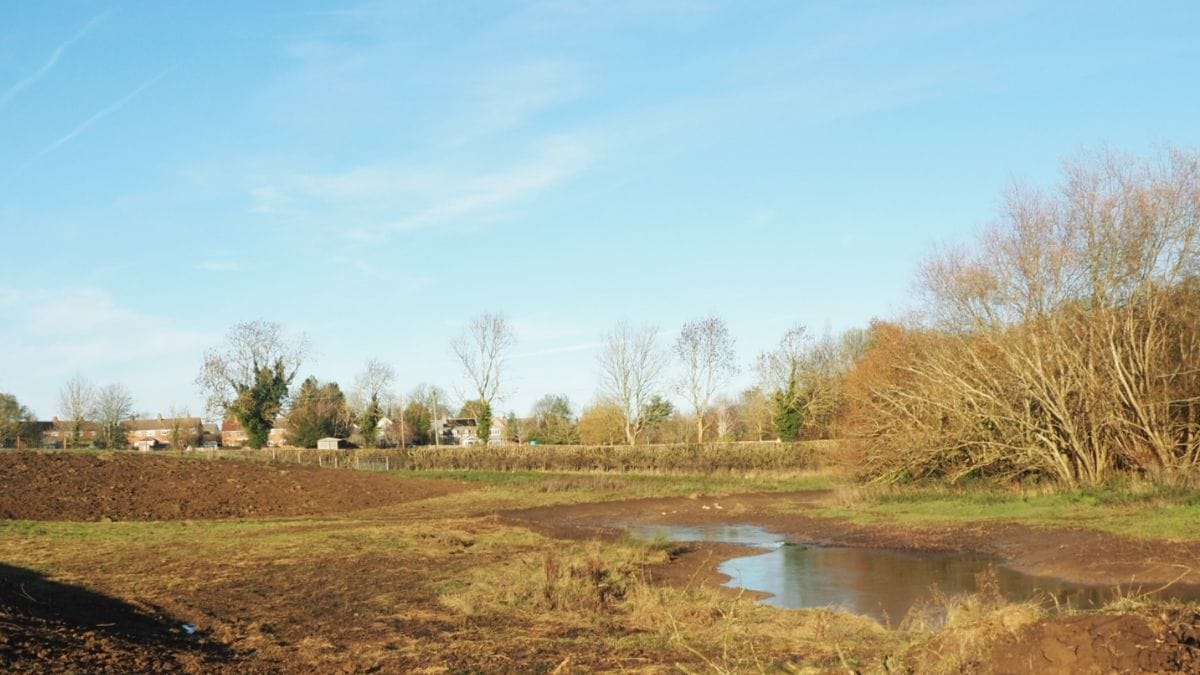
Why we need reliable long-term grants for landowners to accelerate river recovery.
As a local rivers charity, a large part of our impact depends on how effectively we can engage with landowners. This concerns schemes that reduce flood risk, create habitat, intercept pollution, or restore our rivers and landscapes. Making a difference for our rivers depends on the success of conversations with the person or organisation who owns and/or manages the land.
It is a delicate relationship to build. Landowners must balance a range of production, landscape and economic factors. Within these factors, our team of experts creates win-wins for habitat, soils and river health. Without financial support, environmental enhancements take a backseat behind maintaining and developing the farm business, especially when profit margins are tight and the market and climate volatile.
A shifting landscape
The ever-changing options for subsidies offer anything but fertile ground for environmental progress. Since Brexit, farmers have been hit hard by the phasing out of the Basic Payment Scheme. Increasing costs and changing supply chains have resulted in huge financial uncertainty for British farming. The end of subsidies based on the size of the land was promoted to be replaced by a model that would reward positive action for environmental goods and services, paid for by the Environmental Land Management Scheme (ELMS) such as the Sustainable Farming Incentive (SFI). A move that, if implemented well, has been welcomed by environmental groups, including ourselves. The reality proves more complicated and is worryingly uncertain. The scheme has a history of delays, frequent changes and difficulties in accessing payments. The government’s recent announcement that the funding for SFI will be paused for review until 2026 makes it even more difficult to build trust in government grant schemes that support river and nature recovery.
The Sustainable Farming Incentive is vital for widespread impact
A key selling point for SFI, compared to other ELMS, is its accessibility and flexibility. It is attractive for farmers looking to improve the environment alongside their farm business, not relying on priority areas or large-scale commitments. From a river perspective, SFI helps reduce runoff and pollution with a soil health focus, such as requirements for soil management plans, and through options including herbal leys, cover crops and buffer strips. These do not require fundamental changes to the farm business and have helped us support farmers with entry-level commitments. SFI also helps create habitat outside of priority areas and, therefore, increasing connectivity and landscape diversity, supporting nature recovery.
Funding sources to support landowners and nature recovery might become available in the future through higher-tier ELMS. This funding is likely to be very tight and only available to the most ambitious projects. Other funding options, such as developer-financed Biodiversity Net Gain and alternative green finance revenue, may offer large sums of money. However, it is very early days and we don’t have confidence yet that it will be appealing or suitable to many. This adds further uncertainty and makes it harder to build relationships. Our experience proved time and again, when landowners struggle to make business plans based on environmental grant income, they are finding themselves unable to commit to actions supporting our rivers. More worryingly, the little remaining faith on the availability and reliability of environmental schemes filters down to environment Non-Government Organisations like Trent Rivers Trust, causing permanent damage to relationships carefully built.
How we will move forward
Progress moves at the speed of trust. Break this trust and it is a setback that may take years to repair – if ever. Pull a scheme at a moment’s notice and the uncertainty it creates will impact on the willingness to commit to future projects, and could persist in the years to come, even when these are not connected to subsidies.
We will continue to engage with landowners and farmers in challenging conditions and identify opportunities for farming and nature. At the same time, we need to respond to a concerning shift in focus for the farm funding landscape toward landowners that do not rely on food production as a main source of income. It benefits farmers who can whether the uncertainty or are able to commit to larger schemes. This means that we are missing out on the broad base. In the UK, 72% of land is used for agriculture, with half of all farms being small scale family farms, less than 20ha in size. Without an accessible, reliable scheme that can work across the entire landscape, for every farm; our rivers, communities, farmers and wildlife pay the price.
Looking at the bigger picture, the opportunity for the UK farmland to be able to mitigate for the impacts of climate change around drought or flooding has been hugely jeopardised. The disappointment and loss of trust from both the farming and the eNGO community will take time to re-build. Time our rivers, endangered species and communities at flood risk don’t have.